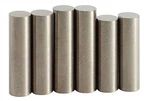
The third link of the preparation process of sintered NdFeB magnets is orientation forming
Magnetic field orientation forming is to use the interaction between magnetic powder and external magnetic field to arrange the easy magnetization direction of powder particles to make it consistent with the final magnetization direction of the magnet. This is the most commonly used method to obtain anisotropic magnets. The powder preparation process breaks the Nd-Fe-B alloy into single crystal particles, which in turn are uniaxially anisotropic, with each particle having only one easy axis—the c-axis of the main phase unit cell. The powder is loosely filled into the mold, and the filling density is about 25%-30% of the real density. Under the action of an external magnetic field above 0.8A/m, these powder particles change from multi-domain to single-domain, and rotate or move them. The easy magnetization direction is adjusted to the direction of the external magnetic field.
In industrial production, the current press forming methods are divided into two categories: one-time forming and two-step forming.
One-time forming can use a unidirectional press (the pressure is generally 50-100MPa, the solid density of the green compact is 55%-60%) or the cold isostatic press (the pressure is generally 200MPa, the solid density of the green compact is 60%) ).
Two-time forming can use a unidirectional press (the pressure is generally 20-30MPa, and the solid density of the green compact is 45%) plus a cold isostatic press (the pressure is generally 200 MPa, and the green density is 60% of the solid density) .
During the orientation forming process, the alloy powder basically retains the state of the c-axis orientation arrangement. After the pressing is completed, the blank is demagnetized (to eliminate the damage of the magnetic dipole interaction between the magnetic powder particles on the orientation of adjacent particles), and then demolded. A blank with good orientation in the easy magnetization direction can be obtained.
The pressure of up to 100 MPa will force the magnetic powder to obey the balance condition of mechanical force and magnetic force, which will inevitably cause the movement or rotation of the magnetic powder particles, which may cause the c-axis to deviate from the direction of the external magnetic field and reduce the orientation of the blank. Therefore, the magnetic field formation process is to reasonably balance the relationship between the magnetic field strength and the forming pressure under the premise of reaching the blank density, so as to obtain the highest degree of orientation as possible.