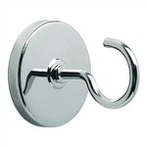
Ferrite magnets are used in many ways in life. Everyone can understand this in many ways, and they can often be seen in many vehicles. But in fact, the main applications of this kind of magnets are in two aspects. One is soft ferrite and the other is permanent ferrite. Let’s listen to the content and applications of these two aspects introduced by Zhixiang! If you are interested, you can take a look!
One, permanent ferrite
This type of magnet can be widely used in the manufacture of permanent magnet starter motors, permanent magnet motors, permanent magnet concentrators, permanent magnet suspension heads, magnetic thrust bearings, magnetic dividers, speakers, microwave devices, magnetic therapy tablets, hearing aids, etc.
There are barium ferrite and strontium ferrite. The resistivity is high and belongs to the semiconductor category, so the eddy current consumption is small, the coercive force is large, and it can be effectively used in the magnetic circuit of the large gap. It is uniquely suitable for permanent magnets for small generators and electric ideas. Because it does not contain precious metals such as nickel, cobalt, etc., the source of raw materials is wonderful, the process is not complicated, and the cost is low, and it can replace AlNiCo permanent magnets. Compared with the large magnetic energy product (B+H) m is low, it is larger than a metal magnet under the condition of equivalent magnetic energy. However, it is worth noting that its temperature stability is poor, its texture is brittle, fragile, and it is not resistant to charge sensation. It is not suitable for measuring instruments and magnetic devices with detailed requirements.
Two, soft ferrite
This type of magnet is generally composed of several parts: single-component or multi-component ferrites such as manganese ferrite, zinc ferrite, nickel-zinc ferrite, manganese-magnesium-zinc ferrite.
has a much higher permeability at high frequencies than metal magnetic materials (including iron-nickel alloys, aluminum-silicon-iron alloys), and is practical for working at frequencies from several kilohertz to several hundred megahertz. The saturation magnetic flux density Bs of ferrite is low, usually only 1/3 to 1/5 of that of iron. The low magnetic energy stored in the unit volume of ferrite limits its use in the low frequency, strong current and high power band boundaries that require higher magnetic energy density. Processing ferrite belongs to the usual ceramic process, so the process is simple, and a large amount of precious metals is saved, and the cost is low. It is more suitable for use in high frequency, low power, and weak current scenes. Nickel-zinc ferrite can be used as the antenna magnetic rod in the radio and the magnetic core of the intermediate frequency transformer, and the manganese-zinc ferrite can be used as the core of the line transmission transformer in the TV receiver. In addition, the soft ferrite is also used in the magnetic core of the intensifier and filter in the communication line. Over the years, it has also been used as a high-frequency magnetic recording transducer (magnetic head).