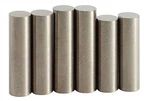
How to distinguish magnets
Magnets are objects or materials that can generate magnetic fields, and are traditionally divided into "permanent and permanent magnets, rare earth permanent magnets, NdFeB permanent magnets, NdFeB strong magnets" and "non-permanent magnets".
Permanent magnets can be natural products, also called natural magnets, or handmade (the strongest magnets are neodymium magnets). They lost their magnetism, not an immortal magnet.
Basic knowledge
The ancient Greeks and Chinese discovered a natural magnet called "magnet" in nature. The stone can suck up small pieces of iron like a trick, always pointing at the same deviation when swinging freely. Early navigators used this magnet as their earliest compass to distinguish directions away from the sea.
After thousands of years of growth, today's magnets have become powerful materials in our lives. Alloys of different materials can achieve the same magnetization effect after decomposition, and can improve the magnetic force. Artificial magnets appeared in the 18th century, but the process of making stronger magnetic materials was very slow. The Alnico was not produced until the 1920s. Subsequently, in the 1950s, ferrites were made in the 1950s, and rare earth magnets were made in the 1970s, including neodymium iron boron (NdFeB) and samarium cobalt (SmCo)]. Magnetic technology has developed rapidly so far, and strong magnetic materials have also allowed components to become smaller.
Magnetization (orientation) deviation
A large number of magnetic materials can be magnetized to saturation along the same bias voltage. This bias is called magnetization bias (orientation bias). Magnets without directional bias (also called isotropic magnets) are much weaker than directional magnets (also called anisotropic magnets).
What is the standard "Arctic and Antarctic" industry definition?
"North Pole" is defined as when a magnet rotates at will, its North Pole points to the Earth's North Pole. Likewise, the south pole of the magnet points to the south pole of the earth.
How can I tell the north pole of a magnet without a label?
Obviously, the eyes can't see it. A compass can be used close to a magnet, and a pointer pointing to the Earth's north pole will point to the magnet's south pole.
How to handle and store magnets quietly?
Always be very careful as the magnets will absorb themselves and will most likely injure your fingers. When the magnets are attracted to each other, they can also damage the magnets themselves by colliding.
Keep magnets away from magnetized items such as floppy disks, credit cards, computer monitors, watches, cell phones, medical supplies, etc.
Magnets should be kept away from pacemakers.
Larger sized magnets, plastic or cardboard spacers should be added between each piece to ensure the magnets can come off easily.
Magnets should be stored in a dry and constant environment.
How did you do the magnetic isolation?
As long as the material that can be adsorbed on the magnet can isolate the magnetic field, and the thicker the material, the better the magnetic separation effect.
Now the most powerful magnets are rare earth magnets, and among rare earth magnets, NdFeB is the strongest magnet. But at temperatures above 200 degrees Celsius, the samarium cobalt magnets are the strongest.